
I spent the last nine months in Norway thanks to the Erasmus program. It was a good amount of time, so I had plenty of opportunities to soak in the local culture and marvel at the cultural differences, which at first were surprisingly numerous but at the same time not as many as I honestly expected. After all, Norway is still a European country (even if not a direct EU member), so even though life in Scandinavia is different from life in the heart of Europe, we still have a lot in common.
In today’s post, I’d like to focus on how Norway made me feel, what parts of it I liked, and which ones I quickly grew to dislike. My personal experience is only and exclusively with Trondheim, so my dear Norwegian friends, don’t be mad at me if I generalize something here that doesn’t apply at all elsewhere in Norway.
The Negatives
First, I’d like to focus on the negative things, where I often found myself thinking that things just work so much better in Czechia.
The prices
We knew Norway was expensive, but we still weren’t prepared for the shock. We could spend days breaking down what things cost in Norway versus Czechia (especially my partner, who did most of the shopping), but I don’t want to needlessly prolong the word count. I just want to mention it for completeness, because it really was insane. It’s no wonder we almost exclusively met students from rich Western countries among other Erasmus students; our Slavic brothers were almost nowhere to be found.
Expensive and low-quality public transport
This is partly related to the previous point, because public transport was absolutely hellishly expensive. For comparison, a student’s yearly pass for the entire city would cost us 12,000 CZK there, compared to about 1,400 CZK in Ostrava. That’s an incredible ten times more expensive. However, it might just be a Trondheim thing; at the beginning of our stay, someone warned us that it has one of the most expensive public transport systems in all of Norway.
And if only the quality of the services matched the price, we wouldn’t have complained so much, but unfortunately, it didn’t. The buses were unreliable, and it happened to us several times that a bus would suddenly change its route without notifying passengers, so we practically ended up at the final stop with no way to prevent it. I still don’t understand how a bus can just do that — just go a different way and let the passengers figure out how to get to their original destination on their own. It makes me appreciate the great public transport we have in Ostrava so much more.
Bureaucracy
Norwegians really love their bureaucracy. Everything has its rules, and as soon as something deviates from the established system, it’s wrong and it can’t be that way. We struggled with it quite a bit at the university, and at the hospital, I also had to deal with several situations where the systems didn’t want to cooperate with us at all.
Once, when we were returning from the hospital after chemotherapy, stressed and with nausea already starting to set in, ticket inspectors got on the bus. We both had valid student tickets and had to show them our student app, proving we really were studying at NTNU. But when my partner couldn’t log in, they stopped the bus for a few minutes because of us and then forced us to get off and walk home, even though we explained the situation and my partner could prove his student status both by accessing other university systems and with a valid physical ISIC card, which is commonly used in Europe. The procedure simply says to use one specific app, and that’s the end of it — no exceptions.
Unfortunately, we experienced similar situations more than once. Norway is great in that its systems work perfectly if a person meets their requirements (for example, if they have Norwegian citizenship), but as soon as something is outside the norm, they sometimes fail and don’t even provide many options for dealing with things in person and individually. I never had a problem writing emails, calling, or even showing up in person, but it was still complicated to find help with some problems.
The necessity of having an app for everything
Digitalization is a great, useful, and modern thing, but sometimes I wonder if it’s going too far. During our first month in Norway, we had to download a huge number of all sorts of apps, without which we wouldn’t have been able to survive there. It’s nice to have everything on your phone, but when you’re trying to prove something to a ticket inspector or you want to open the door to the university cafeteria and your phone is being difficult, there’s literally nothing you can do. For student services, for example, it would be enough to add the option to use a chip in the ISIC card, as it works with locked doors at my university, VŠB.
Surprisingly small product selection
Another thing that surprised me was the limited selection of products in stores (or rather, the lack thereof). It was funny with hygiene products, for example, the store would have three types of deodorant and basically only one shower gel, so at the gym, it was really hard to tell which of the identically-looking bottles was yours. This also applies, for example, to furniture; all the apartments we visited had the same faucet and shower, as if all Norwegians got them from the same person.
It’s similar with clothing, maybe it’s just that I’m not used to it, but it seemed to me that all Norwegians wear the same thing — simple t-shirts, shirts, or polos with no print, light-colored pants or shorts, or maybe a sweater, where at least there were some interesting patterns, and usually some white sneakers. And they all had the same backpack called DoucheBag that’s popular in Norway (if we had to take a shot every time we saw one, we’d die of alcohol poisoning just on the way to the store). It was really rare to see any interestingly dressed people who stood out from the crowd. Now that I’m back in Ostrava, I’m so happy that I’m seeing alternatively dressed people on the streets again who aren’t afraid to look different from others and experiment more with their appearance.
Traffic lights
This is just a small complaint, but the traffic lights in Trondheim are definitely not optimized for pedestrians. It was common for us to have a red light at a crosswalk for several minutes, even though no cars drove by the entire time because they also had a red light. It’s no wonder that people routinely cross on red, the traffic lights here have very little authority.
Rules for pedestrian traffic
This always infuriated us. I thought it was common knowledge that you walk on the right side of the sidewalk, just like on the road, so you avoid collisions with other pedestrians and everything works smoothly. But no, that’s not done in Norway. It’s surprising given their non-confrontational nature, but people here walk on whatever side they want, and when an inevitable collision of trajectories occurs, they don’t even try to get out of the way. They mind their own business, as if it’s everyone else’s duty to make sure they have a clear path.
It annoyed us the most with buses, for some reason, people here don’t realize that there’s a reason why people should get off a bus first and only then get on. I feel like in Czechia, this is taken for granted; if you try to get on a tram before the people inside have had a chance to get off, you’ll probably (and deservedly) get yelled at by a random pentioner, or at least get a lot of unpleasant looks. In Trondheim, however, we noticed that people would stand right in front of the doors at the bus stop, and even when you’re trying to get off the bus, they won’t move an inch, so you have to push your way past them. I still don’t understand how it’s possible that this concept hasn’t been unlocked yet in such a smart and generally great country.
The Norwegian air of superiority
My last point is perhaps a bit strange and I don’t want it to sound offensive, but it’s something we also noticed. Norwegians have a great country that is rich, has a high standard of living, and it seems that their democracy is more successful than almost anyone else’s. They have a rich history, a high level of education, and great prospects for the future. In short, you could say that Norway is one of the best countries, and Norwegians know it very well. They grow up with it, and it’s not surprising that they internalize their superiority, and even if their non-confrontational nature doesn’t allow them to show it much, as a foreigner, you can sometimes feel like you’re somehow beneath them. Especially if you’re not from one of the other good countries like Germany or France, being from Czechia is basically the same as being from Yugoslavia; for the developed West, these are slightly backward and not exactly good states.
No one was outright mean to us, but we never felt completely accepted there. I think that even if we were to move there someday, learn the language, find a job, and eat Brunost for every dinner, we would never belong among Norwegians. They have their national pride (which they undoubtedly deserve to have), and getting into that group as a foreigner is really hard. It sometimes made us a little sad, but in the end, it wasn’t the end of the world, and despite it, we met some great Norwegian friends with whom we felt great.
The Positives
Now we can finally move on to the things that pleasantly surprised me and that I was truly grateful for during my stay.
Nature
It’s no secret that a big draw of Norway is its beautiful nature. As soon as we were flying into Trondheim, I was immediately struck by the desolate plains, which were truly completely empty — you’d sometimes see a few houses by a lake, but it’s a mystery to me how the locals get there because I didn’t see any roads from above. It’s quite a difference from Czechia, where the areas between cities are most often full of fields, and the land looks like a grid of differently colored rectangles from a plane. Norway, on the other hand, looks more like unexplored territory where you’d go on an adventure.
Up close, the nature is also different and truly beautiful. We often went for walks in the Lade district, where our favorite route is along the sea, up and down hills, from whose cliffs you can see beautiful views of both the fjord and the city. The forests there are relatively dense, but I especially liked the amount of moss, lichen, and exposed stone, which together always looked beautiful and epic. In higher areas, however, not much grew, when we went on one such higher hike, we only had to get through low bushes and walked more on stones. We sometimes had to get through a marshy area, but they definitely weren’t dense, tall forests. So, in short, the nature is different but at the same time familiar and truly beautiful.
Architecture
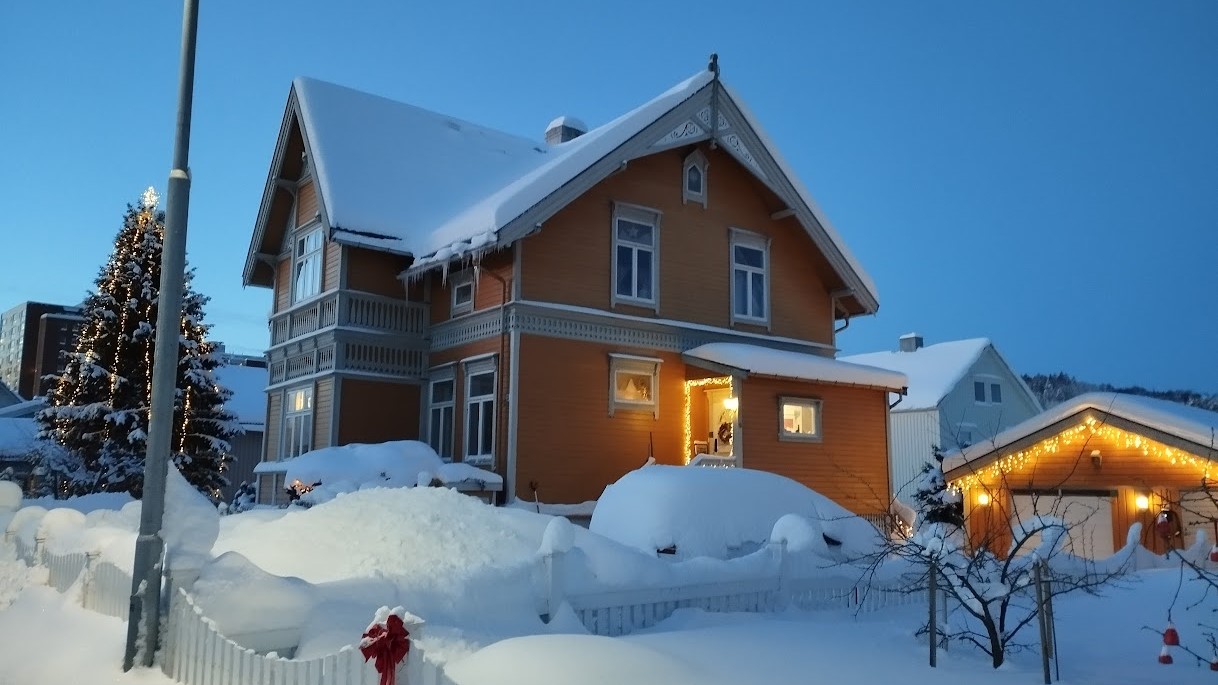
When we first drove through the city on the Flybuss from the airport, it was immediately clear that the family houses all over the city were built in the same style classic to Nordic countries. They are all made of wood, painted in different colors, with white windows and straight, A-frame roofs. When we were still living in the student house near the Lerkendal stadium, every morning we had a view from our window across the street of one such house, red and really pretty. I’ve always liked this style of architecture; the only downside is perhaps that they aren’t exactly built for major heat waves, so when thirties came to Trondheim in the summer, our apartment was a sauna (so we secretly went to sleep in the basement, where the rooms after the Italians were already empty).
However, Norwegians don’t just build traditional wooden family houses; a large part of the buildings in the city are modern. These are concrete and more blocky in character. University buildings in particular are often huge with a large open space in the middle where you can see from the ground floor to the ceiling several stories up, so they are really spacious. And on the other hand, there are also some old buildings in the city, the most beautiful of which are, of course, the Nidarosdomen cathedral (the tallest cathedral in Norway, which unfortunately didn’t make it onto the world list because it’s only 98 meters tall) and the old NTNU university building Gloshaugen (where the library is now, which looks like it’s plucked straight out of Hogwarts).
The coziness level of Norwegian apartments
To add to the previous point, I don’t know if it’s just our luck, but from several visits to our Norwegian friends, I’ve gathered that local apartments are somehow cozier and better equipped than ours. I don’t know what it is, but they always had nicely coordinated colors, wooden furniture in a uniform swatch, and generally looked like their designer knew what they were doing. And they were also always equipped with a lot of string lights, warm lamps, and candles to look nice even during the long and dark Nordic winter.
The cleanliness of public spaces
It’s also commendable how clean the streets are. You’ll really rarely find trash on the ground here, the only exception is used and discarded pouches of under-lip tobacco Snus, which are unfortunately very popular here. Other than that, everything is nice and clean. I like that every plastic bottle and can has a 2 NOK deposit (about 4 CZK), so you often see students with huge bags full of plastic bottles, for which they’ll surely get a decent amount. I also saw older people (in Czechia, I would have said they were homeless, but that’s illegal in Norway, so I’m not sure of their identity) collecting bottles from trash cans and also from students on the streets, who were surprisingly happy to start a conversation with them. I wish we would introduce a similar system in Czechia someday; it’s a great motivation for recycling, and it’s always nice to get your deposit money back.
Safety
Another thing that pleasantly surprised me on the streets of Trondheim is the pervasive sense of safety. Ostrava isn’t exactly a dangerous city, but you can still feel the difference. At night, I wasn’t scared at all to walk alone, the number of weirdos on the street is drastically smaller, and you rarely have to avoid anyone suspicious. The only place where we regularly ran into unpleasant people was the square in front of the Trondheim Torg shopping center, so we preferred not to linger there much.
I was also surprised that people here are completely carefree. They would sometimes just leave their bikes on the street unlocked, and most of our roommates didn’t lock the front door of the house. This backfired on us, however, when one day an unknown thief visited us and took half a kilo of cheese, a container of strawberries, a portable speaker, and also my keys, which were in the pocket of my jacket by the door. When we told our landlord about it, he assured us that we shouldn’t worry about it at all and that he didn’t mind the lost keys, as he had plenty of spares at home. The whole thing was pretty bizarre.
People are nice
And I’m not trying to say that Czechs are a nation of unpleasant people, but a slightly different approach to communication and coexistence was noticeable here. Norwegians most of all non-confrontational. If there’s any way to prevent or avoid conflict, they will always choose that path. People on the street are therefore relatively pleasant, if you make eye contact with someone, they will often smile at you, and if you interact with them, they will be completely polite.
This was also the case with the people I talked to; it was primarily students, but I talked to basically all age groups, including grandmas and grandpas. They were all nice, and even if they weren’t always talkative, we always talked for at least a little while.
But I noticed it most with the nurses at the hospital. They were absolutely amazing, helpful with everything, and even though I caused them problems because they had to speak English with me instead of Norwegian, they never had the slightest problem with it. During my entire hospital escapade, I only ran into two whom I might describe as unpleasant, but even there, I’m not sure if it wasn’t just the language barrier. Otherwise, I only have good experiences with them; they were always pleasant and helped me even during the worst panic attacks and other unpleasant situations.
Everyone speaks English
If you can speak English, you don’t have to worry about not being able to communicate in Norway. Everyone here really speaks English, across all age and social groups. Again, I’d like to mention the local grandmas and grandpas who sometimes had to dust off their English skills, but then we could talk without problems about Czechoslovakia (yes, a lot of people, even the younger ones, unfortunately haven’t heard the news that the Slovaks ran away from us). I can’t imagine what it would be like in the opposite case, if a Norwegian went to Czechia and had to deal with the things I dealt with here. Communication would certainly be much more difficult for them there.
No one understands you
I left this little gem for the end, I think this is an experience that every Erasmus student will relate to. My favorite activity in all nine months in Norway was walking through the streets of Trondheim or riding on crowded public transport and discussing absolutely private things with my partner that we would have saved for a secret conversation at home in Czechia, or just talking about the people standing around us as if it were no big deal. It’s such a freeing feeling, as if we had our own secret encryption, an invented language, so no one understood us at all. And because Czech is a Slavic language, the Germanic or Romance speakers didn’t even have a chance to decipher anything, even if they really tried. We weren’t afraid of other Czechs either; there were so few of us in Trondheim that we met our fellow countrymen at most five times in nine months.
Now that we’re back in Czechia, we have to watch our language so no one on the street beats us up.
In Conclusion
So, as you can see from the word count I managed to conjure up here, there are a lot of differences between Czechia and Norway. Despite all the little flaws that we started discovering during our nine months abroad, it was a great experience. We went through a lot of things, both good and bad. Our Erasmus might not have been exactly standard, but even so, or perhaps because of it, we took a lot away from it. I’m grateful that we were able to spend so much time in Norway, and I truly hope we’ll get to visit again someday.